About the artist
"I’m interested in exploring nature vs synthetic perfection and the need to organise everything into neat, modular systems."
Lorna Freytag is a mixed media artist based in Oban on the north west coast of Scotland. Originally from Edinburgh Lorna studied at Gray’s School of Art and her work has taken her to New York, Sydney, Dubai and London.
Her practice uses pressed flowers and natural materials to explore systems of control, colour, and representation.
Working across modular canvases, oversprayed works, and flag-based forms, she examines how nature is categorised, standardised, and visually organised. Colour plays a central role in her work, functioning as both structure and subject, often referencing industrial palettes, signal systems, and methods of classification.
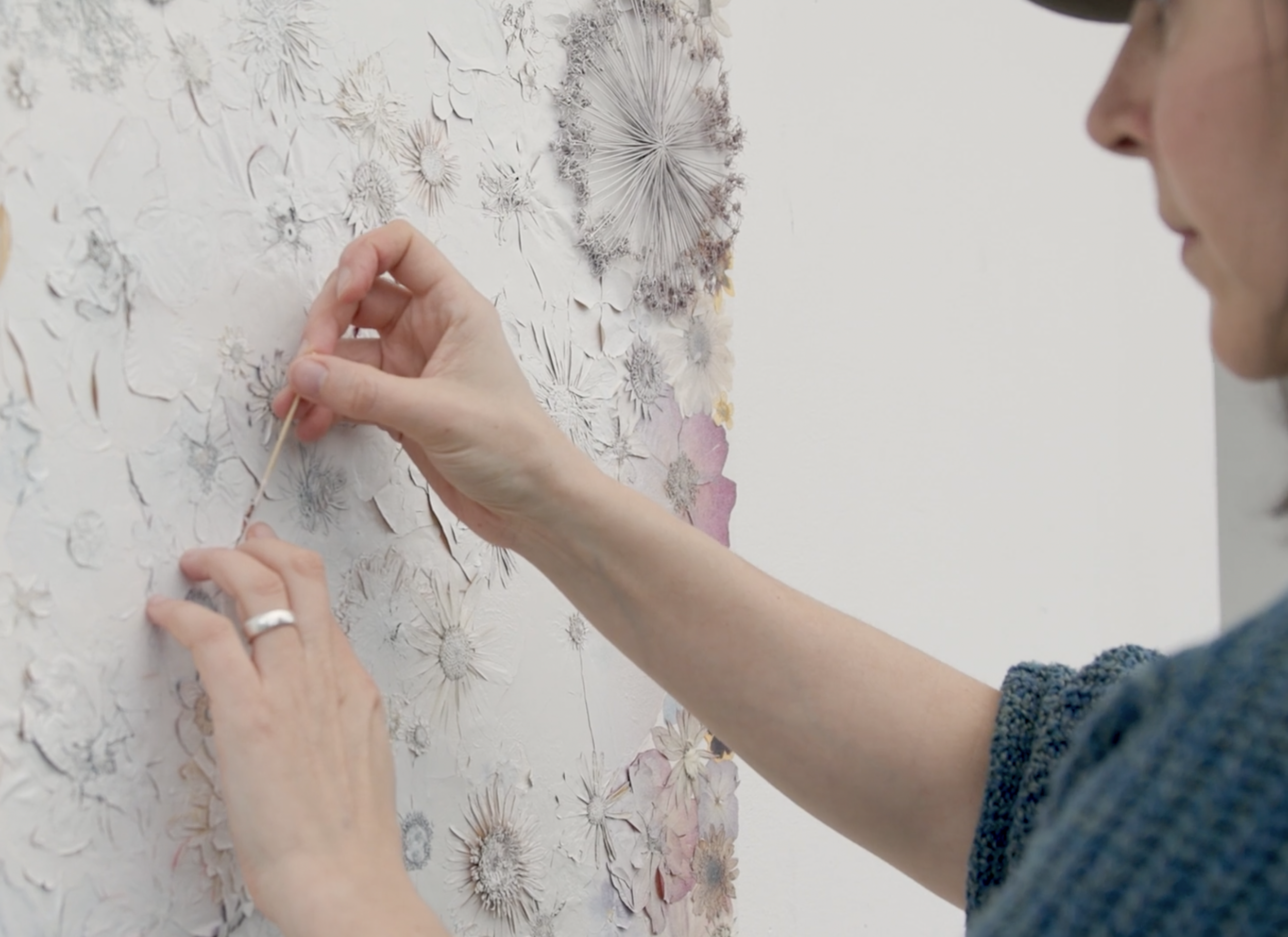
She hand-collects and presses most of her materials using slow, traditional processes that allow time and chance to shape the work, placing organic change in direct conversation with imposed order.
Artist Statement / Colour & Contradiction
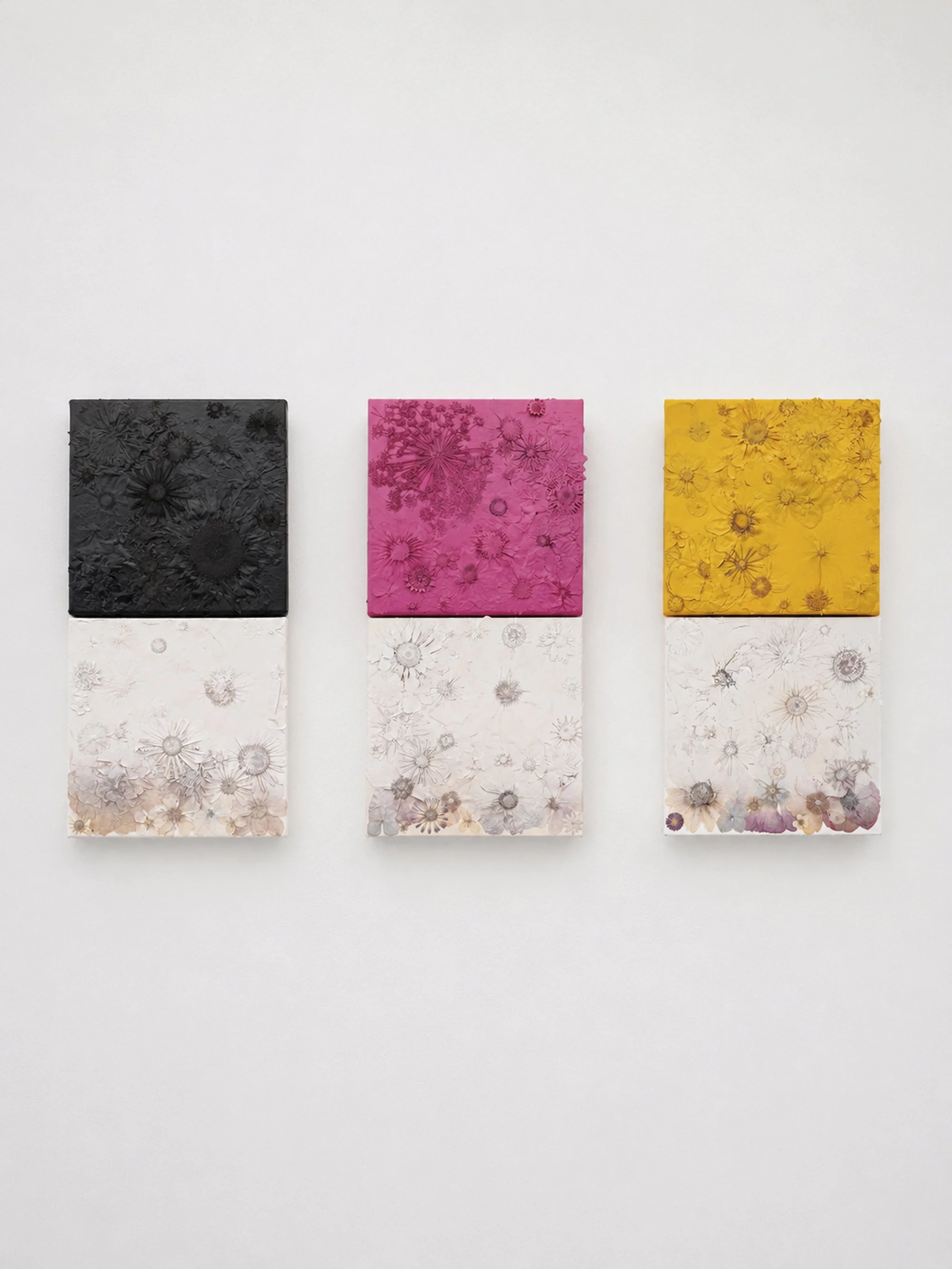
This new body of work explores the tension between natural beauty and our desire to control, categorise, and preserve it. Using pressed flowers alongside synthetic materials and paint, the work questions what happens when something fleeting is pushed towards permanence and perfection.
Each piece is modular, designed to stand alone or be shown in pairs or larger groupings. Together, they create systems of order: colour charts, swatches, samples, and grids. These structures reference the way humans have historically tried to organise nature, from botanical classification to the flower industry itself, reducing living, changing forms into controlled palettes and uniform products.
Within each grouping is at least one panel that retains a small section of untouched pressed flowers. These natural elements will fade and brown over time. Surrounding them are repeated synthetic, oversprayed panels that are fixed, uniform and permanent. They act as colour memory rather than colour truth.
By overspraying flowers with layers of acrylic paint, the work becomes a kind of recipe for synthesising nature, blurring the line between what is real and what is manufactured. The repetition and flatness of colours reference industrial processes, while the flowers resist full control through their texture, irregularity and natural change.
Ultimately, the work exposes our fixation on permanence, uniformity and the artificial reproduction of the natural world.